IELTS Speaking · Part 2

IELTS Speaking Practice Scripts

Five model answers for common Part 2 cue card topics — with bracketed prompts you can personalise. Practise reading them aloud in ScriptScroller to build fluency before your exam.

5 scripts ~240–280 words each Designed for the 2-minute Long Turn

IELTS Speaking Part 2 — the Long Turn — asks you to speak uninterrupted for up to two minutes on a cue card topic. You get one minute to prepare. Most test-takers struggle not because they lack ideas, but because they run out of language under pressure.

The scripts below give you a proven structure for five of the most common cue card categories. Each uses bracketed placeholders so you can drop in your own details before rehearsing. Use ScriptScroller to scroll through your personalised version at speaking pace — this builds fluency far faster than silent reading.
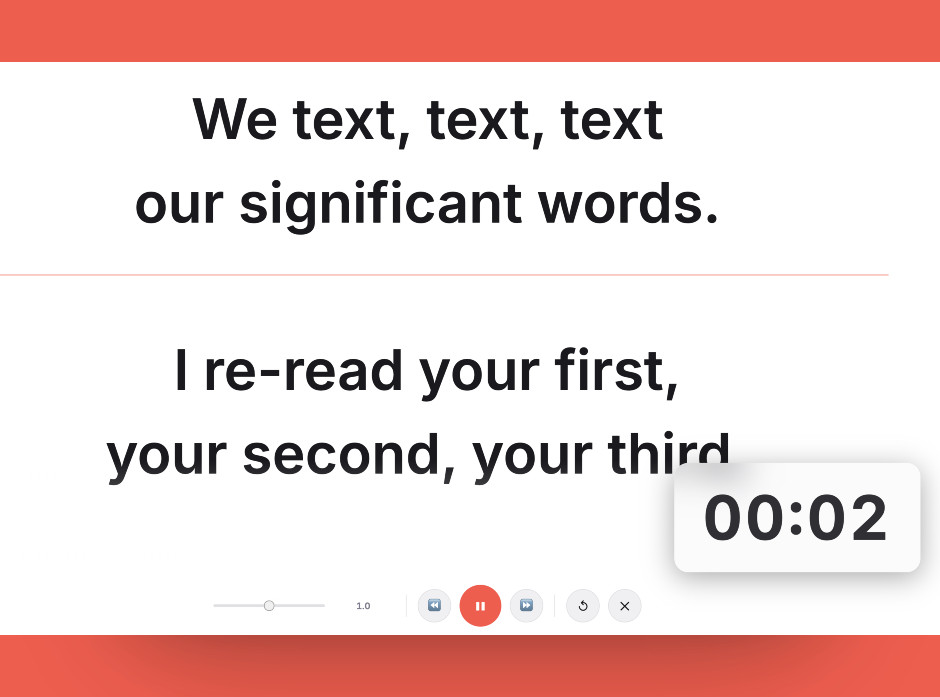
ScriptScroller teleprompter for IELTS speaking practice

How to use these scripts
  1. Choose a topic and fill in every [bracketed placeholder] with your own details.
  2. Click Copy script on the card below, then paste it into ScriptScroller.
  3. Set a comfortable scroll speed (aim for ~130 words per minute) and read aloud.
  4. Practise 3–5 times until the structure feels natural — then try it without the script.

Part 2 Model Scripts

1

Your Ideal Home

Open in teleprompter
Let me give you a quick overview of what my dream living space looks like and why it matters to me. I've spent a long time imagining a home located in [Location — e.g., the Swiss Alps / a quiet coastal town]. Most recently, I've been focusing on the idea of a [Type — e.g., modern glass cabin / restored farmhouse], where the main priority is [Main feature — e.g., natural light and sustainability]. My favourite feature would be [Key detail — e.g., a floor-to-ceiling library with a fireplace]. Before I settled on this idea, I spent time exploring [Earlier preference — e.g., urban loft living], where I developed a love for [Key skill/aesthetic — e.g., minimalist design]. The thread through all of it has been [Core theme — e.g., creating a sanctuary for creativity]. What draws me to this specific vision is [Specific reason — e.g., the way it balances raw nature with modern comfort].

Cue card prompt: "Describe the home you would most like to live in. You should say: where it would be, what it would look like, what your favourite feature would be, and explain why you would like to live there."

2

A Person in a Family Business

Open in teleprompter
I'd like to tell you about [Name], someone I know who is deeply involved in a family-run enterprise. They are currently at [Company Name] as a [Role], where they focus on [Main responsibility — e.g., scaling their grandfather's traditional bakery]. Their biggest contribution there was [Key achievement — e.g., digitising their inventory system for the first time]. Before they joined the family firm, they were at [Earlier Company/School], where they developed [Key skill — e.g., independent marketing strategies]. The thread through their experience has been [Core theme — e.g., balancing tradition with innovation]. What I find most interesting about family businesses is [Genuine observation — e.g., the high level of personal accountability and long-term vision they require].

Cue card prompt: "Describe someone you know who works in a family business. You should say: who they are, what the business does, what their role is, and explain what you find interesting about family businesses."

3

A Teacher You Admired

Open in teleprompter
I'd love to share the impact that [Teacher's Name] had on my education. They taught [Subject], and their primary focus was always on [Main responsibility/teaching style — e.g., making abstract concepts feel tangible]. Their biggest contribution to my growth was [Key achievement — e.g., helping me overcome my fear of public speaking]. Before I entered their class, I was at a point where I struggled with [Skill/Subject], but through their guidance, I developed [Key skill — e.g., critical thinking]. The thread through all of their lessons was [Core theme — e.g., that curiosity is more important than being right]. I admired them specifically because [Specific reason — e.g., they treated every student's question with genuine respect and intellectual rigour].

Cue card prompt: "Describe a teacher who had a great influence on you. You should say: who they were, what subject they taught, how they taught, and explain why they were so influential."

4

A Foreign Food You'd Like to Try

Open in teleprompter
I've been very interested in trying [Food Name], a famous dish from [Country]. I first heard about it after [How you heard about it — e.g., watching a documentary on street food / reading a travel blog], where the main appeal was [Main feature — e.g., the complex fermentation process]. The biggest draw for me is [Key detail — e.g., the unique combination of spicy and floral flavours]. Before I discovered this, I was exploring [Earlier interest — e.g., Mediterranean cuisine], where I developed a palate for [Key skill/taste — e.g., fresh, herb-heavy dishes]. The thread through my culinary interests has been [Core theme — e.g., seeking out authentic cultural stories through flavour]. What draws me to this dish specifically is [Specific reason — e.g., how it represents the history of its region through its ingredients].

Cue card prompt: "Describe a foreign food you would like to try. You should say: what the food is, where it is from, how you learned about it, and explain why you want to try it."

5

A Trip You'd Like to Take Again

Open in teleprompter
I'm genuinely excited to talk about returning to [Location]. I first went there in [Year/Time of life], and during that stay, I focused on [Main activity — e.g., trekking through the backcountry]. My biggest highlight there was [Key achievement/moment — e.g., reaching the summit at sunrise]. Before that trip, I had travelled to [Earlier Place], where I developed [Key skill — e.g., basic navigation and solo-travel confidence]. The thread through why I travel is [Core theme — e.g., finding perspective in wide-open spaces]. What draws me to return to [Location] specifically is [Specific reason — e.g., that there are still hidden trails I haven't explored yet].

Cue card prompt: "Describe a trip you have taken that you would like to repeat. You should say: where you went, when you went, what you did there, and explain why you would like to go again."

Scoring Criteria at a Glance

IELTS Speaking is marked on four equally weighted criteria. These scripts are structured to help you score well across all four:

Criterion What examiners look for How these scripts help
Fluency & Coherence Speaks without long pauses; ideas connect logically Three-paragraph structure with clear linking phrases ("The thread through...", "What draws me...")
Lexical Resource Uses a range of vocabulary accurately Each template introduces topic-specific vocabulary naturally in context
Grammatical Range Uses complex sentences; errors don't impede understanding Mixed tenses, conditionals, and relative clauses built into the structure
Pronunciation Intelligible; some features of connected speech Practising with a teleprompter at natural pace trains rhythm and stress

Frequently Asked Questions

What is IELTS Speaking Part 2?
IELTS Speaking Part 2, also called the Long Turn, requires you to speak for 1–2 minutes on a cue card topic. You are given 1 minute to prepare notes. Topics typically ask you to describe a person, place, object, or experience. You are assessed on fluency, coherence, vocabulary, grammar, and pronunciation.
How can a teleprompter help with IELTS speaking practice?
A teleprompter lets you rehearse a model answer while keeping your eyes forward — simulating the natural eye contact needed in the exam. By reading a well-structured script aloud multiple times using ScriptScroller, you internalise topic vocabulary, practise pacing, and build the muscle memory needed to speak fluently under exam conditions.
Should I memorise my IELTS speaking answer?
Examiners are trained to detect memorised answers and will penalise you for reciting them. Instead, use these model scripts to learn structure and vocabulary, then practise delivering personalised versions naturally. The goal is fluency and coherence — not word-for-word recall.
How long should an IELTS Speaking Part 2 answer be?
You should aim to speak for the full 2 minutes. At a natural pace of roughly 120–150 words per minute, that means preparing around 240–300 words. The scripts on this page are designed to fit comfortably within that window.
What are the most common IELTS Speaking Part 2 topics?
Common cue card categories include: people (a friend, teacher, or public figure), places (a city, building, or natural feature), experiences (a trip, celebration, or achievement), objects (a gift, gadget, or piece of clothing), and abstract topics (a time you were happy, a skill you want to learn). The five scripts above cover the most frequently reported topics from recent test-takers.

Practise your script right now

ScriptScroller is a free online teleprompter. Paste your personalised script and start reading aloud in seconds — no account needed.